

Sciatica vs Disc Pain: How to Tell the Difference
Sciatica and disc pain are terms that get used interchangeably — even by clinicians. They’re not the same thing, and they don’t always require the same approach. Here’s how to tell them apart, what’s actually driving each presentation, and why the distinction matters for your recovery.
What disc pain actually feels like
Disc-generated pain — also called discogenic pain — arises from the disc itself, either through mechanical deformation of the disc wall or chemical irritation from nucleus material making contact with pain-sensitive structures in the outer annulus.
It tends to present as a deep, central, or paracentral lower back ache. It’s often worse with flexion — sitting, bending forward, loading the spine in a rounded position. Many patients describe it as a constant dull ache with episodic sharp flares when they move in a particular direction.
Crucially, discogenic pain does not necessarily refer down the leg. You can have significant disc pathology — a genuine bulge or herniation — and experience pain only in the lower back.
What sciatica actually is
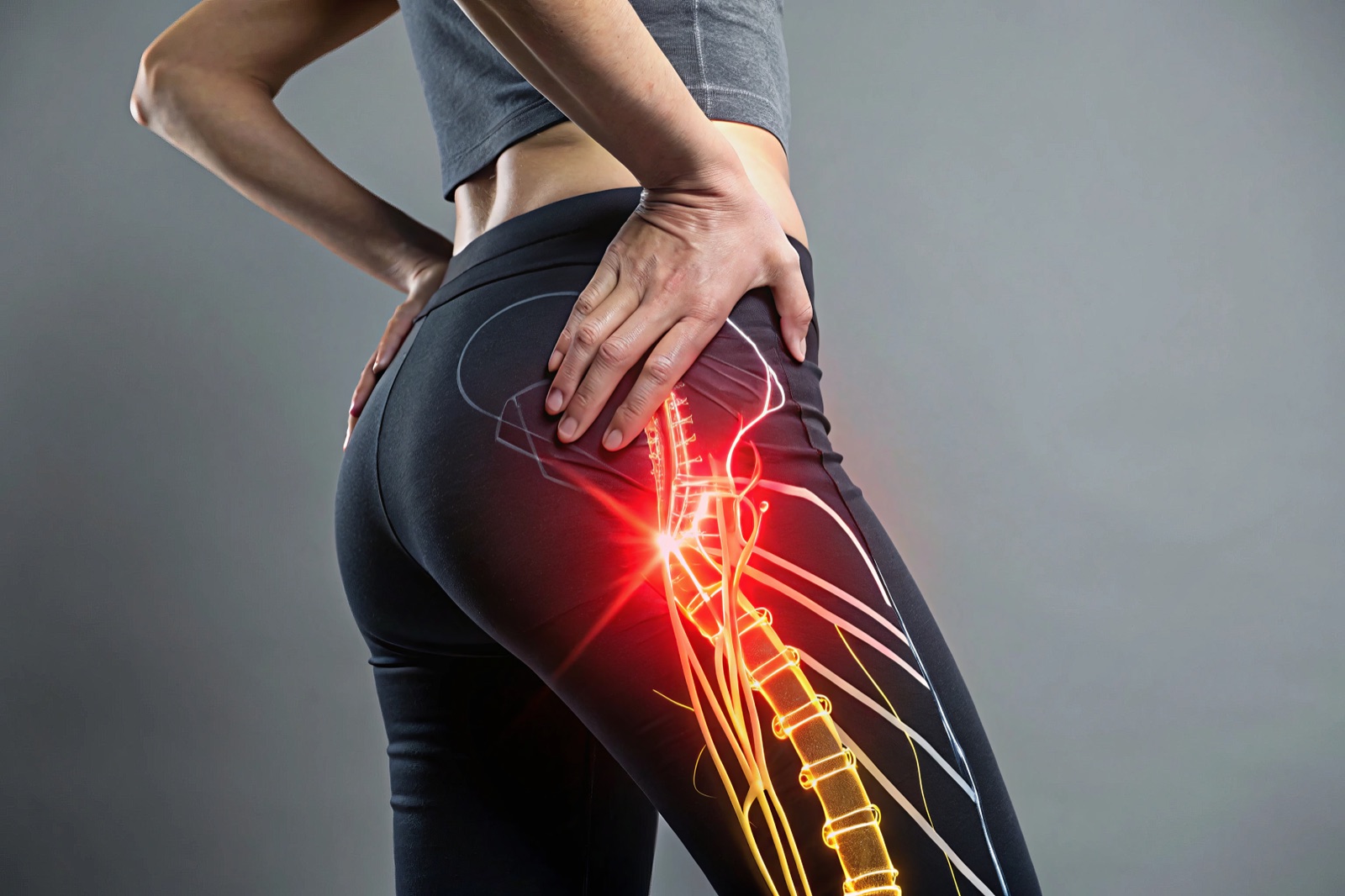
Sciatica is a specific symptom, not a diagnosis. It describes pain that radiates from the lower back through the buttock and into the leg, following the path of the sciatic nerve. It can extend as far as the calf and foot, and is often accompanied by numbness, tingling, pins and needles, or weakness in the affected leg.
In the clinical sense, sciatica means a nerve root is being irritated or compressed somewhere along its course. The most common cause is a disc bulge or herniation at L4/L5 or L5/S1 — the lowest two lumbar levels — where disc material encroaches on the nerve root as it exits the spinal canal.
But disc compression is not the only cause of sciatic symptoms. Piriformis syndrome, spinal stenosis, facet joint inflammation, and sacroiliac joint dysfunction can all produce leg pain that mimics classic sciatica. This is why an accurate diagnosis matters — treating the wrong structure produces frustrating results.
Disc Pain — typical presentation
- Deep central or paracentral lower back ache
- Worse with sustained sitting or forward flexion
- Episodic sharp flares with movement
- May not refer into the leg at all
- Often relieved by lying flat
Sciatica — typical presentation
- Pain radiating from back into buttock and leg
- May include numbness, tingling, or weakness
- Follows a dermatomal pattern (L4, L5, or S1)
- Often worse with coughing or sneezing
- Positive straight leg raise test
How we differentiate them clinically
At Shift, we use a combination of history, orthopaedic testing, and functional assessment to determine whether a patient’s presentation is primarily discogenic, nerve-root mediated, or both.
Key indicators that point toward disc-level nerve root compression — the type of sciatica that responds best to MT Core Smart Decompression — include:
- Pain that follows a clear dermatomal pattern (L4, L5, or S1 nerve root distributions)
- Symptoms aggravated by positions that increase intradiscal pressure — sustained sitting, forward flexion
- Centralisation with repeated extension: pain moving from the leg back toward the lower back is a strong positive prognostic sign
- Positive straight leg raise or femoral nerve tension tests
- Correlation between symptoms and disc pathology on imaging
Why the distinction matters for treatment
True disc-driven sciatica — where a bulge or herniation at L4/L5 or L5/S1 is compressing a nerve root — is one of the conditions that responds most consistently to MT Core Smart Decompression. The computer-guided tension cycles create negative intradiscal pressure specifically at the affected level, drawing the disc material back and relieving the mechanical compression on the nerve root. Most patients with this presentation notice a meaningful reduction in leg symptoms within the first several sessions.
Where the sciatic presentation is driven by a different structure — piriformis, sacroiliac joint, or facet joint — the approach shifts toward chiropractic manipulation, soft tissue work, and targeted rehabilitation. Often both mechanisms are present simultaneously, and the treatment programme needs to address both.
This is precisely why Shift’s model integrates chiropractic care, MT Core Smart Decompression, and the Shift 4 rehabilitation framework — not as separate offerings, but as a single clinical pathway shaped by what’s actually driving your symptoms.
The MT Core Smart Decompression is the only mechanical decompression unit of its kind in South Australia. For patients whose sciatica is driven by disc-level nerve root compression, its real-time computer-guided tension cycles deliver the precision needed to address the source — not just manage the referred pain in the leg.
Not sure whether your leg pain is disc-driven sciatica or something else? A Spinal Health Assessment will give you a clear clinical answer — and a pathway forward.