

What Actually Happens to a Disc When It Bulges — And Can It Heal?
Most people are told they have a bulging disc and sent on their way. Here’s what’s actually happening inside the disc — and why most conventional approaches never give it a real chance to heal.
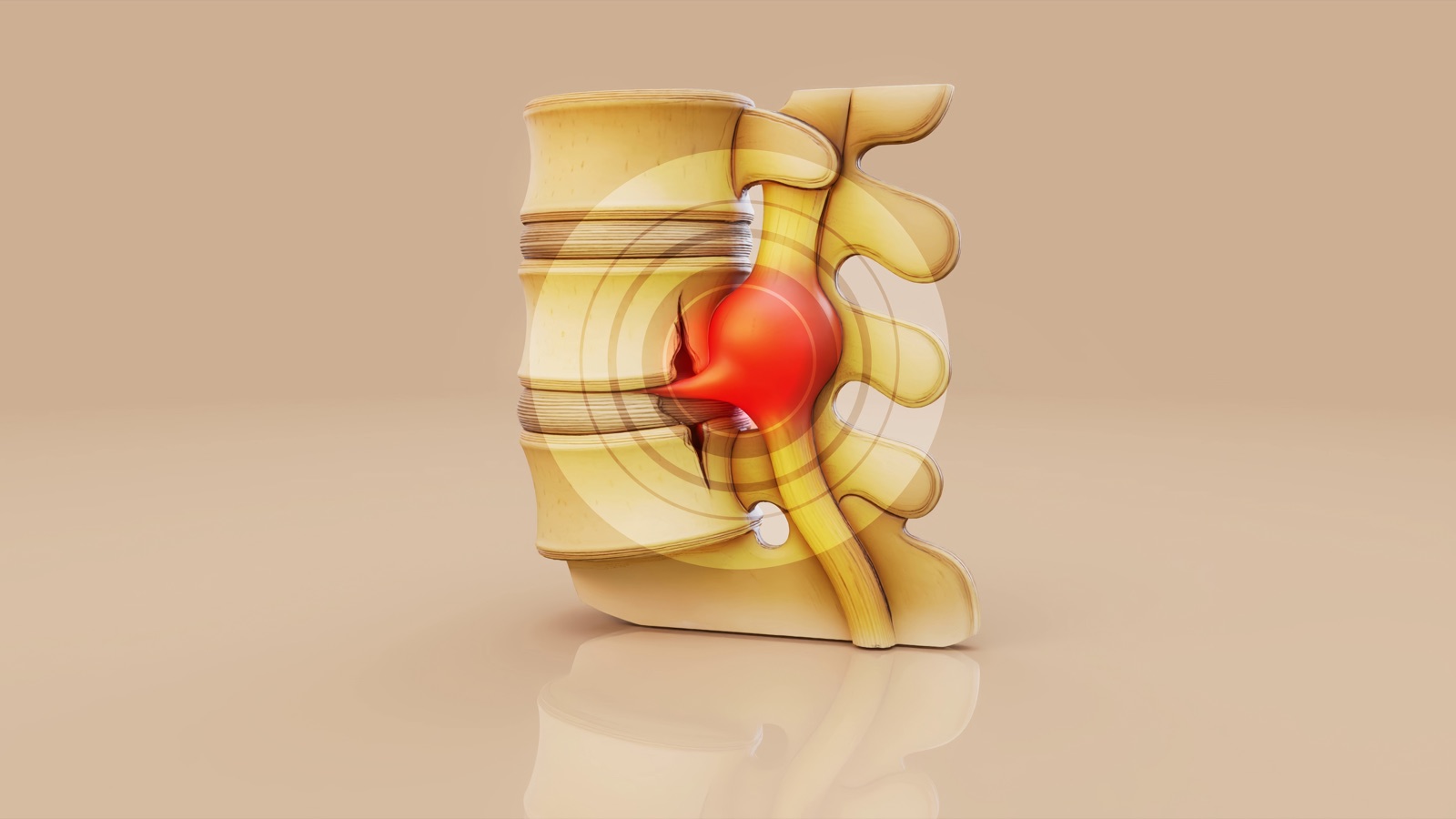
What a disc actually is
Your spinal discs sit between each vertebra and do two things simultaneously: they act as shock absorbers, distributing compressive load across the spine, and they act as spacers, maintaining the height of each vertebral segment so nerve roots can exit freely.
Each disc has two components. The outer ring — the annulus fibrosus — is a tough, layered structure of collagen fibres wound at alternating angles, like a bias-ply tyre. The inner core — the nucleus pulposus — is a gel-like substance composed largely of water and proteoglycans, which are molecules that attract and hold fluid under pressure.
In a healthy disc, the nucleus is roughly 80% water. That hydration is what gives it height, compliance, and load-distributing capacity. Lose the hydration and the disc loses its ability to function.
What a bulge actually means
A disc bulge occurs when the fibres of the annulus weaken or sustain micro-tears, allowing the nucleus to shift toward the disc wall and push it outward. The disc doesn’t rupture — the annulus remains intact — but it deforms beyond its normal boundary.
This matters clinically because the posterior disc wall sits immediately adjacent to the spinal canal and the nerve root exit points. Even a modest posterior or posterolateral bulge can encroach on a nerve root, producing the classic combination of local back pain, referred leg pain, and in some cases sciatica.
A herniation is a more advanced version of the same process — where the nucleus material has pushed through a tear in the annulus, rather than simply distending it.
Why the disc struggles to heal on its own
Here is the problem that makes disc injuries fundamentally different from most musculoskeletal injuries: the disc has virtually no direct blood supply.
Most tissues heal by receiving oxygen, nutrients, and inflammatory mediators through the bloodstream. The disc cannot do this — it is the largest avascular structure in the human body. Instead, it depends entirely on a process called imbibition: the mechanical pumping of nutrients in and waste products out through alternating compression and decompression of the disc.
In practice, this means movement is medicine for disc health — but only the right kind of movement, at the right disc level, under controlled conditions. Most people with a disc bulge move less (understandably, because it hurts), which further reduces imbibition and compounds the problem.
Why most treatment approaches stop short
Anti-inflammatories, rest, and passive physiotherapy can manage symptoms effectively in the short term. The pain settles, the patient feels better, and treatment stops.
But none of these interventions address the underlying disc environment. The disc remains dehydrated, mechanically compromised, and unsupported. Minor provocations — a long drive, a sneeze, picking something up at an awkward angle — are enough to re-aggravate it. This is why so many people with disc injuries cycle through flare-ups for years.
How the MT Core Smart Decompression changes the equation
The MT Core Smart Decompression is the technology we use at Shift Spinal Health to mechanically address the disc environment directly — something that passive treatment and standard chiropractic care alone cannot achieve.
Unlike conventional traction, which applies a generalised pull across multiple disc levels, the MT Core uses computer-guided tension cycles to create a targeted negative pressure environment at the specific disc responsible for your symptoms. This negative intradiscal pressure does two clinically important things:
- It draws the bulging disc material back toward the nucleus, reducing encroachment on the nerve root.
- It recreates the pressure differential the disc needs to draw in fluid, oxygen, and nutrients — restoring the conditions for genuine biological repair.
The MT Core Smart Decompression is the only mechanical decompression unit of its kind in South Australia. Its computer-controlled tension cycles respond in real time to paraspinal muscle resistance — ensuring the decompressive force reaches the target disc level rather than being absorbed by the surrounding musculature. This precision is what makes it clinically different from anything else available in Adelaide.
So — can a disc actually heal?
Yes. Disc material can reabsorb over time, annular fibres can remodel, and disc height can be partially restored — but only when the mechanical environment supports it. That means consistent negative intradiscal pressure to enable imbibition, combined with stabilisation of the surrounding musculature so the disc isn’t repeatedly reloaded before healing can take hold.
This is the framework behind every recovery programme at Shift: decompress the disc with the MT Core, stabilise the spine with targeted rehabilitation, and build the functional strength to protect it long-term. Getting out of pain is Stage 1. Keeping you out of pain is Stages 2 and 3.
Ready to find out what’s actually happening with your disc — and whether the MT Core Smart Decompression is right for you?