

Spinal Decompression
A Body That Responds When You Need It: Dr Jonathan Maszak on the Rebuild Program
Most people come to us because their back hurts, and getting them out of pain matters. But at Shift Spinal Health it is only the starting point. We sat down with Principal Chiropractor Dr Jonathan Maszak to talk about Rebuild, the clinic’s structured decompression and strength program, and why he built it the way he did.
Let’s start simple. What is Rebuild?
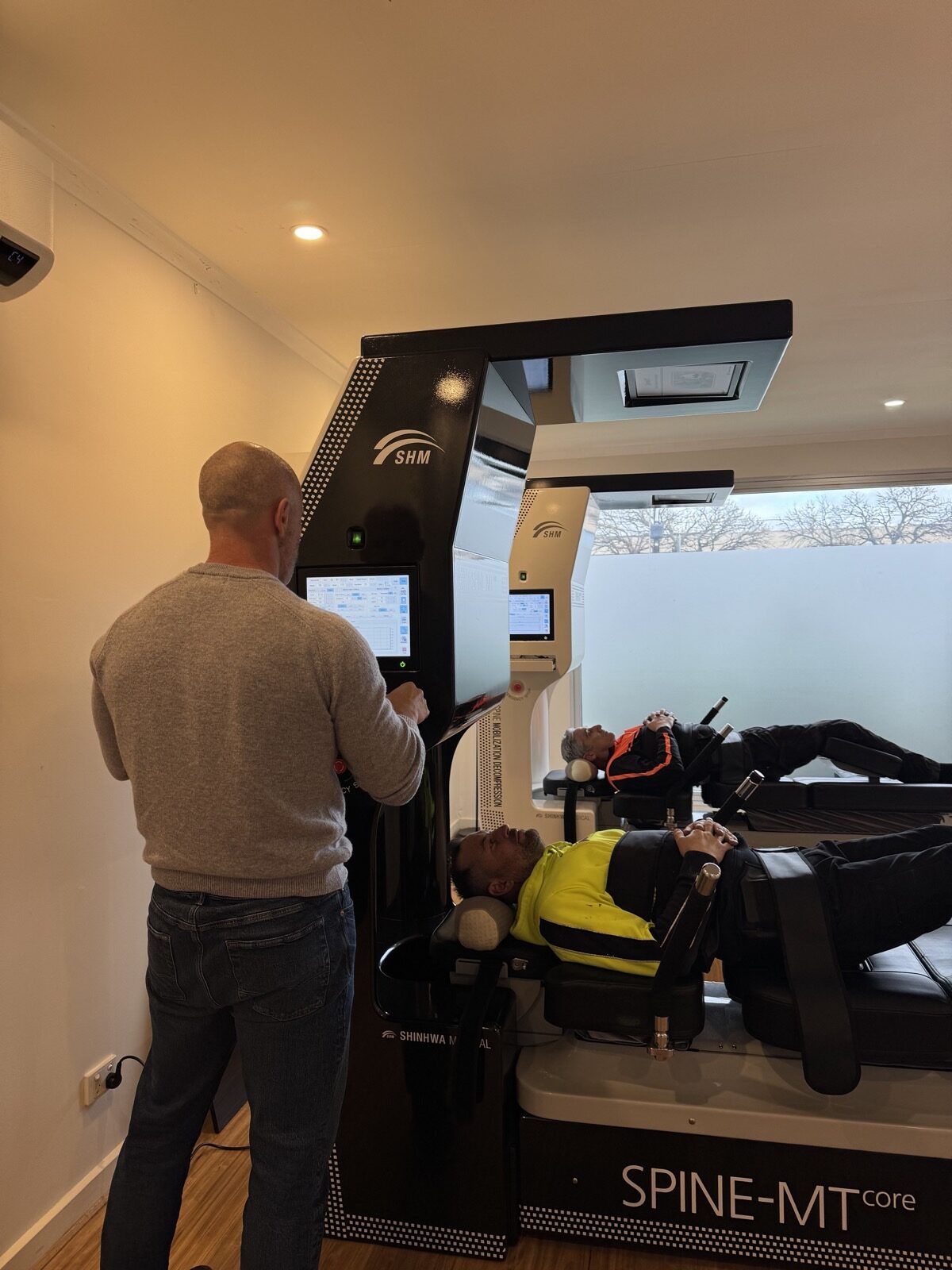
Rebuild is a structured, supervised program that combines MT Core Smart Decompression with progressive strength work, coached by your clinician the whole way through. The idea is to unload the spine first, then build the strength to hold it, and over time protect what you have built. A lot of care stops the moment someone feels a bit better. Rebuild is designed to keep going until the body is genuinely doing its job again. It is also not for everyone, and we are upfront about that. We only put people on it when it is the right fit.
Who is it for?
Two things, really. Clinically, it is built for more complex presentations: complex disc injuries, facet joint pain, and degenerative joint disease. These are the situations where a few visits and some rest were never going to be enough. Beyond that, it suits a particular kind of person. Someone with a problem that keeps returning, who has already tried rest, medication or hands-on treatment and wants more structure behind it. Someone weighing up surgery who wants to understand a conservative option first. Someone ready to do the work rather than have it done to them, who wants a clear path rather than booking in again and again with no sense of direction. If that sounds like you, Rebuild is the conversation worth having at your assessment. And if it is not, that is fine too. Not everyone needs a program.
You mentioned MT Core Smart Decompression. What actually happens in a session?
It is a treatment you receive lying down on a purpose built table. The table is heated, and most people find it comfortable from the start. You relax and the table does the work through a controlled, gentle motion. Nothing is asked of you during the session. Your frequency is set by your clinician based on your presentation, and it eases as you progress. We introduced MT Core Smart Decompression to South Australia because we wanted a consistent, repeatable treatment we could build a proper program around.
How does the strength work fit in with the decompression?
They come together as one plan rather than two separate phases. We think of it as unload, build, then protect. The decompression creates the conditions, and strength is what holds them. The strength side is introduced when you are ready for it, not on a fixed day. You start with a coached one-on-one session in our clinic gym so your technique is set properly, then your program moves onto our app to follow between visits, advancing as your capacity grows. Over time the focus shifts from recovering to keeping what you have built.
A lot of clinics promise results. How do you handle that?
I do not like promises in this field, because bodies are individual and honest care means saying so. What I would rather give people is something they can see. Every Rebuild patient gets a Shift Score, which measures where you are across five markers, scored out of 100. We re-check it every 4 weeks, then adapt your program to what we find. So instead of me telling you that you are improving, you can look at the number and compare it to last time. It turns progress into something visible rather than something you take on faith.
What is the Shift Score measuring?
Real, physical capacity. The five markers are back endurance, strength under load, movement confidence, nerve mobility, and side and core endurance. Each is worth 20 points, and 80 out of 100 is the benchmark we work toward together. It is not about how you feel on the day, although that matters too. It is about what your body can actually do. Reaching 80 is what moves you on, rather than a date on the calendar.
So how long is someone on the program?
Three to six months is the typical range, and that is the mindset we ask people to come in with. Spinal tissue and strength both change slowly, and a program that respects that will serve you better than one built around a short block of visits. But there is no fixed term and no block of weeks we sell you. Your Shift Score guides when you are ready to move on, not the calendar. Some people get there sooner, some need longer, and both are completely normal.
What happens when someone reaches that point?
That is where the philosophy really shows. A spine that responds when you need it. Once you are moving well and holding the strength you have built, you can step into Elevate, our continuation program, or you can simply graduate and get on with your life. Your clinician talks you through the options at your graduation review. It is completely optional. The point is that the choice is yours and the foundation is already built.
Why the gym membership feel rather than a traditional treatment plan?
Because that framing matches what we are actually doing. We unload the spine, then we build strength, and strength is something you develop over time with consistency. Nobody expects to get fit from four visits to a gym, and spinal health is no different. There is no lump sum and no fixed term. You are building something over time, the way you would with strength training, rather than buying a block of treatments.
People sometimes assume a program like this is out of reach. What does it actually cost?
Less than most people expect. Rebuild is $140 a week, and that covers all of your MT Core Smart Decompression sessions, full access to our clinic gym, and the rehab app we built ourselves, for as long as your program runs. It is billed as $280 a fortnight by direct debit, and you can cancel any time. There is no lump sum and no minimum term. The app was built in house around established practice in disc rehab, video guided on your phone, so your program travels with you between visits and you always know what to do.
Do I have to be on a program to use the decompression beds?
No. You do not need to be on Rebuild to use them. We offer casual sessions for anyone who just wants the decompression on its own, with no plan required. Plenty of people come in with general stiffness or an everyday ache and simply want the treatment, and we will not push a program on someone who does not need one. Rebuild is for people who want the decompression, the strength work and the tracking brought together into one structured plan.
If someone reads this and thinks it might be for them, what is the first step?
Book a Spinal Health Assessment. It is $140 and runs 45 to 60 minutes, and where it makes clinical sense on the day your first MT Core Smart Decompression session is included, so you leave having actually experienced the treatment. We examine your spine, go through your history and any imaging, and talk about what you are trying to get back to. Then we take those findings away and sit down with you at a second visit for your Report of Findings, where we explain what we found and what your plan would look like. That is also where we recommend a path. It might be Rebuild, it might be decompression on its own, or it might be something else entirely, including a referral if that is what your case calls for. Booking commits you to nothing beyond the assessment itself.
Any last word?
Just that the goal was never to make the pain quiet for a week. The goal is a body that responds when you need it. That is what we are building toward with every person who starts Rebuild.
Ready to see if Rebuild is right for you?
Book a Spinal Health Assessment with Dr Jonathan Maszak. We will look at what is going on, talk through whether the Rebuild program is the right fit, and recommend the right path from here. You can also compare our programs to see where Rebuild sits.
Book a Spinal Health Assessment →
$140 · 45 to 60 minutes · includes your first decompression session where clinically appropriate.